A volunteer's experiences in Orissa

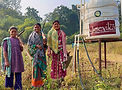
As a PUM volunteer, I have been conducting training for two weeks for two groups of each 25 women in a rural village in Orissa. PUM is a Dutch organization that provides knowledge rather than financial aid. My focus is on sharing basic knowledge regarding (organic) agriculture and on the exchange of information. I use an interactive approach, in the hope that the information will stick better.
I hereby resume the language barrier as my greatest handicap. The participants do not speak English, and I have to get used to my interpreters' English pronunciation—and they to mine. I rely on my interpreter and the project staff, who sometimes struggle to suppress the urge to answer my questions on the women's behalf or who, in their enthusiasm, tend to interject their own knowledge. I realize that my ‘challenging’ or ‘unconventional’ questions—intended to draw the participants out and get them thinking—are difficult for the interpreter to translate, especially without insight into what I aim to achieve with the line of questioning. On the other hand, it is a win-win situation if my training provides the project staff with a tool to share their agricultural knowledge. I hope that the local project staff will be able to pass on the information from my training themselves in the future.
What makes working here—compared to working in the Netherlands—an extra challenge is the fact that the majority of participants do not appear accustomed to abstract thinking. This means that conveying basic theoretical knowledge requires a concrete approach using concrete examples. It is only then that you realize how often we are in the habit of resorting to abstract comparisons, diagrams, or images.
This means that people learn by doing. By experiencing themselves. But also learn from each other’s mistakes and by exchanging experiences and knowledge. For that, but also for mutual cooperation, trust is needed. That is why, in a playful way, I have paid attention to building trust. I employed several game-based techniques that required teamwork. This quickly provided insight into the group dynamics and identified the informal leaders. These leaders were the ones who took the initiative during visits to the fieldplots, asked questions, and helped me explain the material to the other participants in a way they could easily understand.
Participants engage well and are motivated to learn, provided the material is immediately applicable. It proves difficult, however, to explain that a certain level of foundational knowledge is essential for sustainable development. People tend to prefer ready-made solutions for specific problems, whereas our abstract approach inclines us to think in terms of cause and effect. We aim to provide insight into the underlying causes, hoping that participants will be able to arrive at a solution themselves next time.
I came to Orissa driven by idealism, hoping to use my knowledge to help improve the living conditions of the rural population. But I also came partly for myself. Volunteering offers a unique opportunity to get to know a country from the inside—to experience the culture and witness local customs firsthand. I enjoy the motorcycle rides, the temple visits, and, above all, interacting with the people.
There is still much to learn—for me as well. Both short-term gains and long-term benefits are essential. However, there is a discrepancy in expectations among the local population. We aim to contribute to the long term—to a sustainable future—whereas local expectations tend to focus on short-term benefits. It is up to us to find a way to navigate this.
Paul Geelen, PUM Netherlands. Bhubanneswar, 8 June 2026


Comments